
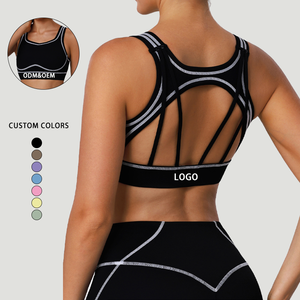
Encapsulation & Compression
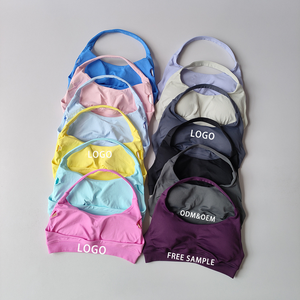
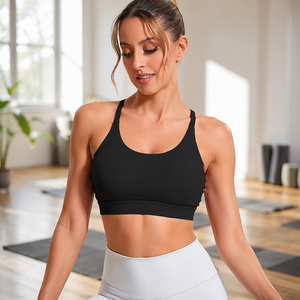
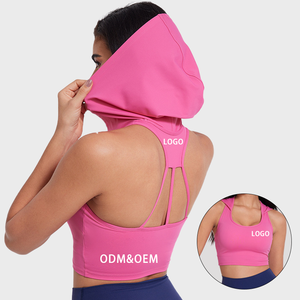
Women Color Block Sport Yoga Gym Running Workout Fitness Padded Bras High Impact Support Activewear Tank Crop Top Sports Bra
High Gauge 28G
Shock Reduction
Removable Pads
Precision-engineered compression support, high-gauge Santoni seamless knitting, moisture-wicking synthetic matrixes, and ergonomic anatomical contouring customized to your technical design packs.
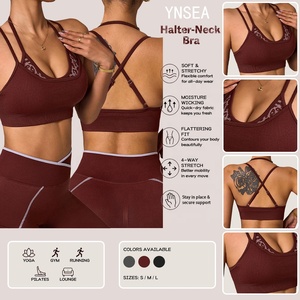
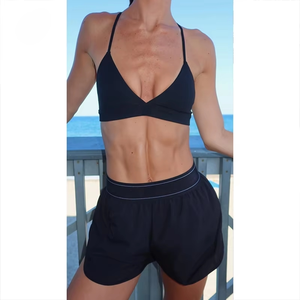
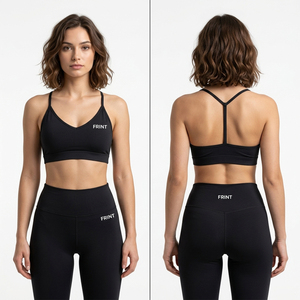
As the international activewear landscape shifts from basic cut-and-sew manufacturing toward high-tech bio-synthetic textiles and localized supply chains, procurement directors must structure contracts around the following paradigm shifts.
Traditional compression sports bras rely on uniform high-elastane tension, resulting in uncomfortable breast tissue flattening and restricted breathing. Procurement demand has swung heavily toward variable-tension circular knitting. Using selective jacquard patterning on Santoni Top2V machines, we knit localized encapsulation pockets directly into single-piece tubes, maintaining breast ligament stabilization (Cooper's ligaments) without steel underwires or bulky laminations.
Import compliance in the European Union and North America now mandates rigorous verification of chemical management (OEKO-TEX Standard 100, ZDHC) and recycled fiber authenticity (Global Recycled Standard). Leading sportswear exporters are pivoting directly from virgin petro-chemical nylon to bio-based polyamides (castor bean origin) and recycled sea-waste filament (ECONYL® equivalent), providing end-to-end chain-of-custody documentation for customs clearance.
The post-knitting finishing sector has evolved past traditional flatlock stitching. Edge finishes, armhole perimeters, and underband transitions are increasingly executed using ultrasonic edge trimming matched with thermo-polyurethane (TPU) adhesive film activation. This creates an unstitched, 0.4mm micro-profile that completely eliminates friction chafing during 20,000+ cycle running gaits while boosting tensile longevity after 50 commercial laundry cycles.
A prime sourcing hazard for B2B sports bra buyers is fabric hysteresis: the irreversible sagging and elasticity loss caused by heat, sweat acidity, and high mechanical strain. Technical specification sheets now enforce elastane wrapping specifications, such as air-jet texturing double-covered Spandex (Lycra® T902C) core-spun yarns. This preserves a sub-4% hysteresis curve across 12 months of active athletic wear usage, protecting brand ratings on DTC channels.
With market volatility penalizing excessive warehouse inventories, international activewear retail conglomerates are moving away from traditional 10,000-piece container runs. Sourcing strategies focus on agile OEM suppliers capable of sub-1,000 piece pilot productions. Brands leverage core undyed greige tubes, executing rapid piece-dyeing or garment-dye washings in reactive colorways within 10-day sprint cycles based on live TikTok and Shopify real-time sell-through data.
Sports bras face extreme localized perspiration accumulation in the sternum cleavage and inferior breast crease. Leading manufacturers implement thermal-body mapping during Santoni CAD drafting. Open-work diamond and micro-mesh channels are knitted using dual-layer hydrophobic (Polypropylene inside) and hydrophilic (Nylon 6.6 outside) yarns, physically pulling liquid sweat away from the athlete's skin by capillary differential rather than using temporary wash-out chemical coatings.
Why Tier-1 sportswear distributors, boutique gym franchises, and private label e-commerce merchants entrust their sports bra manufacturing lines directly to our production floors.
Garments are knitted to exact anatomical contours on our proprietary 20-machine battery of Italian Santoni Top2V circular systems. Knitting is executed in-house, preventing seam failure and preserving gauge uniformity throughout the production lot.
From micro-denier Nylon 6.6 to dope-dyed heathered yarns, we source and test raw fiber cones for color fastness (Grade 4.5+), tensile burst strength, and lint resistance prior to machine loading, backing every colorway with spectrophotometer lab dips.
Because programming, tubular knitting, and flatlock assembly stay under one manufacturing roof, technical proto-samples are cut, pressed, and dispatched within 5 to 7 days, shaving weeks off your seasonal development schedules.
We eliminate impossible barrier-to-entry order thresholds by establishing realistic 1,000-piece style minimums. Importers can split a single run into two functional sizes and three distinct color treatments to maximize sales velocity across customer demographics.
Direct commercial, technical, and operational responses designed to streamline vendor vetting for sports bra buyers, apparel sourcing teams, and inventory controllers.
Our standard manufacturing baseline is 1,000 pieces per style. Within that 1,000-piece allocation, we allow brands to partition quantities across up to 2 size tiers (e.g., 500 Medium / 500 Large) and up to 3 lab-approved colorways. Fully custom jacquard patterns requiring complex Santoni machine reconfiguration carry their own style-specific 1,000-piece minimum run.
Seamless sports bras are tubular knit directly into circular forms on machines like our Santoni Top2V, embedding compression, mesh air-permeability, and structural underbands into a single contiguous yarn structure. Cut-and-sew manufacturing cuts flat knitted rolls into panels and stitches them together with bulky side seams, increasing fabric waste by 18-25% and exposing high-friction body points to potential chafing.
Once your tech pack parameters, yarn selections, and Pantone TPX codes are locked, initial counter-samples are produced and shipped within 5 to 7 operational days. Because our programming engineers sit ten feet from our operational circular knitting floor, we modify machine loop density and strap tension immediately without off-site subcontracting delays.
Yes. If you have an existing golden master garment or benchmark activewear sample, our textile engineers can deconstruct the fiber composition, stitch density, elastane core thickness, and dimensional underband tension. We reverse-engineer the garment into a digital Santoni machine script and prepare a commercial grading matrix across sizes XS through 3XL.
We execute strict AQL 2.5/4.0 inspection standards. Quality controllers test elastane elongation recovery via constant-rate tension testers, measure dry and wet crocking color fastness, verify dimensional shrinkage following AATCC home laundering methods, and check for dropped stitches under high-lumen light tables prior to inserting custom woven labels, silicone branding badges, and compostable polybag packaging.
We routinely export under Incoterms including FOB, CIF, DDP, and EXW depending on your logistics architecture. Our export documentation team supplies full Commercial Invoices, Packing Lists with volumetric weight manifests, Certificates of Origin (CO), Form A / EUR.1 (where relevant), and GRS synthetic yarn transaction certificates to facilitate seamless customs clearance.